How to Dispose of Unused or Expired Medicine Safely
Leftover medicine is a poisoning and misuse risk. Use a take-back program first; trash only as a last resort; flush only if on the FDA flush list.
A bathroom cabinet full of half-finished bottles is one of the most common — and most overlooked — household hazards. Those leftover pills are not harmless once a course is done. They are a poisoning risk for children and pets, a temptation for anyone who might misuse them, and a source of drugs that end up in the wrong hands or the water supply.
The good news is that disposing of medicine safely is straightforward. There is a clear order of preference, and only the last option is “just toss it.”
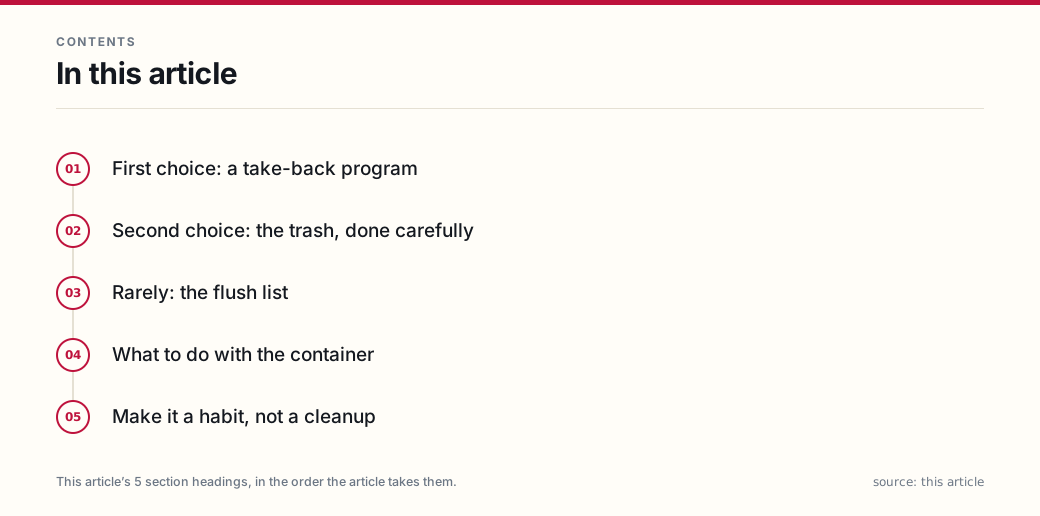
First choice: a take-back program
A drug take-back is the safest route. You hand the medicine to a controlled collection point and it is destroyed through proper channels.
- The U.S. Drug Enforcement Administration runs National Prescription Drug Take Back Days and keeps a locator for year-round collection sites.
- Many pharmacies, hospitals, and police stations accept unused medicine on an ongoing basis.
- Some communities run mail-back or drop-box programs.
Take-back is best because it removes the drugs entirely — no trash, no water, no chance of someone finding them later. Use it whenever it is available. (A few states have their own drug-disposal rules on top of the federal guidance, so check local requirements too.)
Second choice: the trash, done carefully
If no take-back option is nearby, household trash is the fallback — but never loose in the bottle. The recommended method:
- Keep the medicine in its original container if possible.
- Mix the pills, liquids, or patches with something unappealing — used coffee grounds, dirt, or cat litter.
- Seal the mixture in a plastic bag or a container you can close.
- Scratch out or remove any personal information on the label so the prescription cannot be traced to you.
- Put the sealed container in the household trash.
The point is to make the medicine useless and unrecognizable before it leaves your home.
Rarely: the flush list
Flushing should be the exception, not the habit. Most medicines should not be flushed, because they can pass through treatment systems and enter waterways.
There is a short federal list — maintained by the FDA — of potent opioids and a few other drugs considered safe to flush when a take-back is not available, because the danger of keeping them outweighs the environmental concern. If your medicine is on that list, flushing is acceptable. If it is not, do not flush it. Never assume flushing is the easy default.
What to do with the container
Whatever path you use, deal with the label. Prescription bottles carry your name, your doctor, and the drug name — information worth protecting. Scratch it out, peel the label, or remove it before the container goes in the recycling or trash.
Make it a habit, not a cleanup
The simplest way to avoid the disposal problem is to avoid the pile-up. Only fill prescriptions you will use, ask your prescriber about smaller quantities when appropriate, and clear the cabinet once or twice a year. If you are unsure whether an old drug is still worth keeping, the date on the bottle is a starting point — see how drug expiration dates work — but the safer move is to dispose of anything unfinished and unneeded rather than store it “just in case.”
Two related cautions: combining leftover drugs without checking can cause a duplicate active ingredient problem, and choosing a generic vs. brand is a separate decision from safe disposal. Neither changes the basic rule — finished or unused medicine belongs in a take-back, not in the cabinet.
This article is general education, not medical advice. Ask your pharmacist or prescriber about disposing of any specific medicine, especially controlled substances.
Frequently asked questions
- What is the safest way to get rid of old medicine?
- A drug take-back program. The U.S. Drug Enforcement Administration runs National Prescription Drug Take Back Days and maintains year-round collection site information, and many local pharmacies and police stations accept unused medicine. This keeps drugs out of the trash, water, and the hands of anyone who might misuse them.
- Can I just throw medicine in the household trash?
- Only as a last resort, and only done carefully: mix the pills with something unappealing like used coffee grounds or cat litter, seal the mixture in a bag or container, scratch out personal information on the label, and place it in the trash. This is the fallback when no take-back option is available — not the first choice.
- Is it okay to flush old medicine down the toilet?
- Only if the label or a federal flush list says so. Most medicines should not be flushed, because they can enter the water system. The U.S. Food and Drug Administration publishes a short list of opioids and other medicines considered safe to flush when a take-back is not available. If your medicine is not on that list, do not flush it.
- Why does leftover medicine at home matter?
- Unused prescriptions are a leading source of accidental poisoning in children and of misuse by visitors or household members. A finished course of antibiotics or an old opioid sitting in a cabinet is a risk that grows the longer it sits there. Disposing of it promptly closes that risk.
- Do expiration dates mean the medicine is dangerous after that day?
- Not necessarily dangerous, but effectiveness is not guaranteed past the date, and storage conditions matter. The bigger home-safety problem is simply having unused drugs on hand at all. See [how drug expiration dates work](https://health.omc.center/drug-expiration-dates/) for what the date does and does not mean.
Sources
Each source is a primary or official reference, checked before publication. Links open the original.
- U.S. Drug Enforcement Administration — 'National Prescription Drug Take Back Day' campaign page (deadiversion.usdoj.gov/drug_disposal/takeback/): the national take-back event the article describes, with location lookup and the list of what sites accept
- U.S. Drug Enforcement Administration — year-round collection site locator (apps.deadiversion.usdoj.gov/pubdispsearch/): the search the article points readers to when a Take Back Day is months away
- U.S. Food and Drug Administration (FDA) — 'Where and How to Dispose of Unused Medicines' and the FDA flush list: the federal guidance on take-back, trash disposal, and the short list of medicines safe to flush