How Much Caffeine Is Too Much? The FDA's 400 mg Guide
The FDA says 400 mg a day is fine for most adults — about 2–3 twelve-ounce coffees. Here's what's in your drinks, the hidden sources, and when to cut back.
Caffeine is one of the most widely consumed stimulants in the American diet, and the FDA says it can be part of a healthy one. The agency’s working number is 400 milligrams a day for most adults — about two to three 12-ounce cups of coffee. But “most adults” and “about” are doing real work in that sentence: sensitivity varies from person to person, containers don’t, and caffeine hides in more places than the coffee pot.
What is the FDA’s 400 mg number, and what does it actually say?
The FDA has cited 400 mg a day as an amount “not generally associated with negative effects” for most adults. That framing matters. It is a level below which negative effects are not generally expected, not a goal to hit, and it assumes good health. Body weight, medications, and certain medical conditions change the picture, and people metabolize caffeine at very different speeds — two people can drink the same cup and feel noticeably different things.
A 2017 systematic review by the Institute for the Advancement of Food and Nutrition Sciences confirmed the safety of the 400 mg level for most adults, which is why the figure keeps reappearing in FDA guidance rather than being a casual rule of thumb.
How much caffeine is in your drinks?
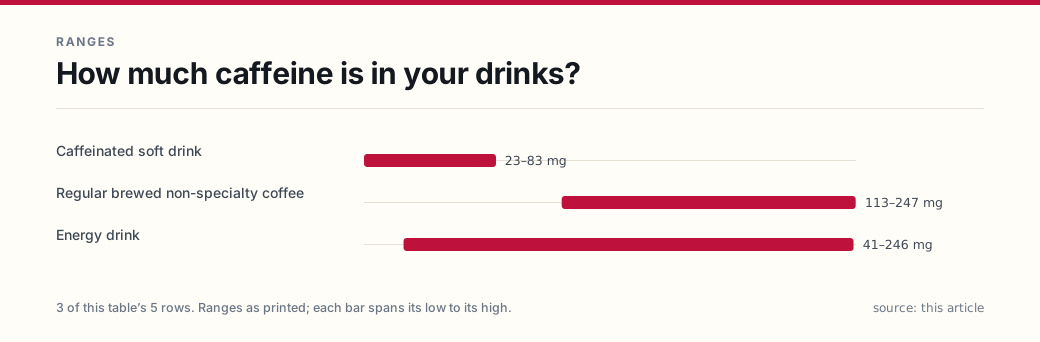
The FDA publishes typical amounts for 12-fluid-ounce servings. Note that 12 ounces is smaller than many cups sold today — a large coffee-shop drink can hold two of these servings or more.
| Drink (12 fl oz) | Typical caffeine |
|---|---|
| Caffeinated soft drink | 23–83 mg |
| Green tea | 37 mg |
| Black tea | 71 mg |
| Regular brewed non-specialty coffee | 113–247 mg |
| Energy drink | 41–246 mg |
Energy drinks have no FDA regulation specific to them — only the general food-ingredient rules apply — and the FDA says they generally run 54–328 mg per 16 fluid ounces. If you track your intake, the can or bottle — not the category name — is the number that counts. Most energy drinks sold in the U.S. list the total caffeine from all sources, including added ingredients like guarana, on the label.
Where is caffeine hidden?
Caffeine turns up where people don’t expect it: energy and protein bars, ice cream, chewing gum, dietary supplements, and over-the-counter medications — especially some pain relievers and “alertness” products. “Decaffeinated” also does not mean caffeine-free: decaf coffee typically has 2–15 mg in an 8-ounce cup. Your body handles natural and added caffeine the same way, so every source counts toward the same total.
What does the label have to tell you about caffeine?
- When caffeine is added as a stand-alone ingredient, it must appear in the food’s ingredient list.
- When caffeine arrives inside another ingredient — chocolate, for example — that ingredient is listed but not flagged as “caffeine.”
- Many products voluntarily state the amount, but restaurants and retail food establishments are not required by law to tell you how much caffeine is in what they serve. It’s a reasonable thing to ask.
What about children, teens, and pregnancy?
The American Academy of Pediatrics advises against energy drinks for children and teens, citing their caffeine and sugar levels. Too much caffeine in this age group can raise heart rate and blood pressure, cause palpitations and anxiety, and disrupt sleep and digestion. The Dietary Guidelines for Americans go further for the youngest: drinks containing caffeine should be avoided for children younger than age 2. The FDA’s own advice for parents is to talk with a health care professional about a child’s or teen’s caffeine consumption.
If you are pregnant, trying to become pregnant, or breastfeeding, the FDA does not set a number. It recommends talking with your health care provider about whether to limit caffeine, because that guidance comes from your clinician rather than a general threshold.
What happens at the dangerous end: 1,200 mg and pure caffeine?
At roughly 1,200 mg consumed quickly — less than half a teaspoon of pure caffeine — the FDA estimates toxic effects such as seizures can occur. The real hazard is concentrated powder or liquid caffeine sold in bulk as a dietary supplement: one measurement mistake can deliver a toxic or even lethal dose, and these products have been linked to deaths. The FDA has taken action against sellers while warning that some remain on the market. Of everything on this page, this is the one product to avoid entirely.
What are the signs you’ve had too much — and how do you cut back?
Common signals include a racing heart, palpitations, high blood pressure, insomnia, anxiety, jitters, upset stomach, nausea, and headache. If you’re a daily drinker and want to cut back, taper gradually: caffeine withdrawal isn’t considered dangerous, but it can be unpleasant, with headache and fatigue as the usual complaints.
What is the bottom line on caffeine?
For most healthy adults, 400 mg a day is a ceiling of caution, not a goal. Count all sources, watch the serving size, keep energy drinks away from kids and teens, skip pure caffeine powders, and treat the number as a starting point that your own body adjusts. If you have a heart condition, are pregnant, or take medications, ask your clinician what level makes sense for you.
Frequently asked questions
- Is 400 mg of caffeine a day safe?
- For most healthy adults, the FDA has cited 400 mg a day as an amount not generally associated with negative effects — roughly two to three 12-ounce cups of coffee. It is a level of caution, not a target to reach. Sensitivity, medications, and certain medical conditions can make a lower intake more comfortable for you, and people metabolize caffeine at different speeds.
- How much caffeine is in a cup of coffee?
- Per the FDA, a 12-fluid-ounce serving of regular brewed coffee typically contains 113 to 247 milligrams. Specialty drinks and large sizes can hold more, so a single large coffee-shop drink can approach or exceed the daily figure on its own. Decaf coffee, by comparison, typically has 2 to 15 milligrams in an 8-ounce cup.
- Are energy drinks more dangerous than coffee?
- Not inherently, but their caffeine content spans a wide range — the FDA says energy drinks generally contain 54 to 328 milligrams per 16 fluid ounces, with some brands higher per serving. The American Academy of Pediatrics advises against them for children and teens because of their caffeine and sugar levels, and large container sizes make it easy to take in a lot quickly.
- Is decaf coffee caffeine-free?
- No. Decaffeinated coffee and tea have less caffeine than their regular counterparts but still contain some — decaf coffee typically has 2 to 15 milligrams in an 8-fluid-ounce cup. That matters mainly if you react strongly to caffeine or are strictly limiting intake; for most people it is a rounding error.
- How much caffeine is dangerous at once?
- The FDA estimates that rapid consumption of around 1,200 milligrams — less than half a teaspoon of pure caffeine — can cause toxic effects such as seizures. Pure and highly concentrated caffeine products, sold in bulk as dietary supplements, are the real hazard: a single serving mistake can be lethal, and these products have been linked to deaths. They are the one caffeine product to avoid entirely.
Sources
Each source is a primary or official reference, checked before publication. Links open the original.
- U.S. Food and Drug Administration — consumer update 'Spilling the Beans: How Much Caffeine is Too Much?' (400 mg a day for most adults; typical caffeine amounts by drink; energy drinks 54–328 mg per 16 fl oz; toxic effects at roughly 1,200 mg or less than 1/2 teaspoon of pure caffeine; label-disclosure rules; gradual-taper guidance; cites a 2017 systematic review by the Institute for the Advancement of Food and Nutrition Sciences confirming the 400 mg level)
- American Academy of Pediatrics — guidance advising against energy drinks for children and teens, cited by the FDA for the caffeine and sugar levels in those products
- Dietary Guidelines for Americans — recommendation that drinks containing caffeine be avoided for children younger than age 2
- U.S. Department of Agriculture — Food Data Central, the FDA-referenced database for caffeine levels in foods and beverages