How much water should you drink? The official table, and what counts
The official numbers are Adequate Intakes measured in total water, set from survey medians. What they actually say, what counts toward them, and when they rise.
Sometime today you will decide whether to refill the water bottle — and how much to drink, and whether the coffee you already had counts. The honest answer comes in three parts, and only one of them is a number: the official Adequate Intake for someone in your situation, the fact that the number measures total water rather than glasses of plain water, and the short list of conditions that push the number up on a given day.
The official table
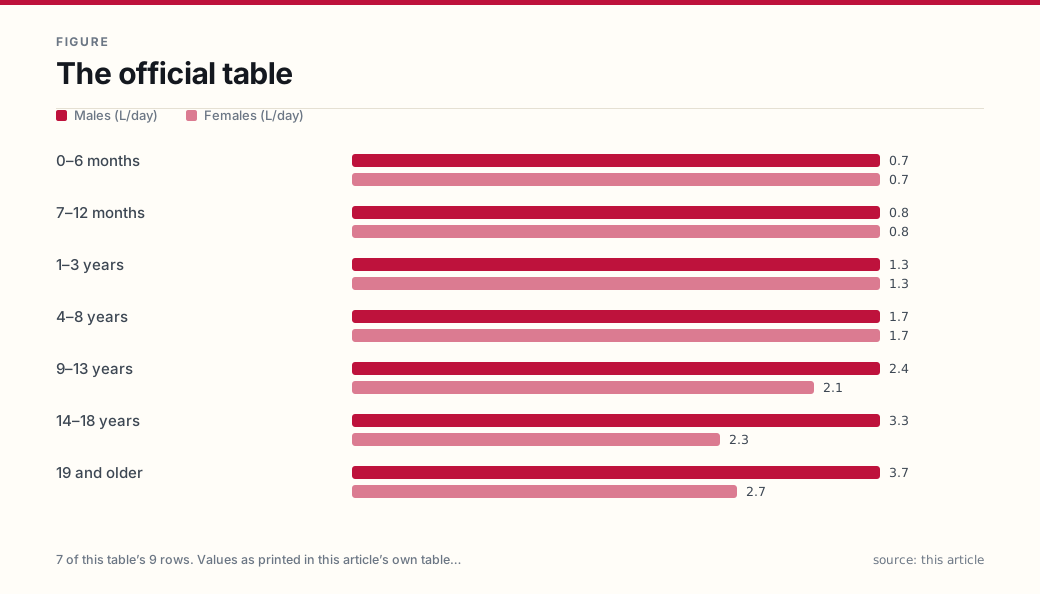
The reference values for water in the United States are the Adequate Intakes (AIs) set by the Institute of Medicine — a nongovernmental scientific body, now part of the National Academies — in its 2005 Dietary Reference Intakes report. An AI is the intake level the panel judged adequate for a population group when the evidence could not support a firmer requirement. For total water, the values run:
| Age | Males (L/day) | Females (L/day) |
|---|---|---|
| 0–6 months | 0.7 | 0.7 |
| 7–12 months | 0.8 | 0.8 |
| 1–3 years | 1.3 | 1.3 |
| 4–8 years | 1.7 | 1.7 |
| 9–13 years | 2.4 | 2.1 |
| 14–18 years | 3.3 | 2.3 |
| 19 and older | 3.7 | 2.7 |
| Pregnancy (14–50) | — | 3.0 |
| Lactation (14–50) | — | 3.8 |
Two details in that table change how it should be read. First, the measure is total water: drinking water, the water in other beverages, and the moisture in food, all added together. Second, the infant rows are not drinking-water targets at all — the criterion behind the 0-to-6-month value is the average consumption of water from human milk.
For the two adult rows, the report prints its own conversion factors — 1 liter equals 33.8 fluid ounces, 1 cup equals 8 — and applying them, 3.7 liters comes to about 125 fluid ounces (roughly 15½ cups) and 2.7 liters to about 91 (11⅓ cups). Those are cups of total water, not of what you pour from the tap.
What the number is — and what it is not
The AI for total water was not derived from physiology experiments. It is the median total water intake reported in NHANES III, the federal survey that ran from 1988 to 1994: the panel set the bar at what apparently healthy Americans already drank, on the assumption that a population maintaining itself at normal hydration is, in aggregate, getting enough. In that survey, fluids — beverages and drinking water — provided about 3.0 liters (101 fluid ounces, roughly 13 cups) a day for men aged 19 through 30 and 2.2 liters (74 fluid ounces, about 9 cups) for women, with the remainder arriving in food.
That origin matters, because an AI is the weakest kind of reference value. The report states that the AI is not equivalent to a Recommended Dietary Allowance. It also says where the AI still fits: where no RDA exists, it is the appropriate reference intake value to use in assessing and planning the nutrient intake of individuals, and usual intake at or above the AI has a low probability of inadequacy. Then it says plainly what the value is not: for a healthy person, daily consumption below the AI may not confer additional risk, because wide ranges of intakes are compatible with normal hydration. In the report’s own words, the AI should not be interpreted as a specific requirement. It is a population median wearing the clothes of a recommendation — useful as a reference point, not a daily quota to fail at.
What counts toward it
Because the number measures total water, almost everything you drink is inside it. The report found approximately 80 percent of total water intake comes from drinking beverages and water; in its survey table, the split is about 81 percent from beverages and drinking water and 19 percent from water contained in food. And it adds that no single source is essential for normal physiological function and health.
The beverage list is wider than plain water. Addressing the long-running question about coffee, the report states that while the diuretic effects of beverages containing caffeine and alcohol have been shown in some studies, available information indicates the effect may be transient, and that such beverages contribute to total water intake. The CDC’s consumer guidance runs in the same direction: plain drinking water counts toward the daily total, foods — especially fruits and vegetables with high water content — can add to it, and its list of low- or no-calorie drink choices includes plain coffee and teas, sparkling water, seltzers, and flavored waters.
When the number goes up
The table values describe people in ordinary circumstances, and the report is explicit that they do not cover everyone’s day: higher intakes of total water will be required for those who are physically active or exposed to hot environments. Body water deficits can develop over just a few hours when sweat losses rise or when intake drops. The National Library of Medicine’s MedlinePlus service frames the same variability in one line: how much you need depends on your size, activity level, and the weather where you live.
The CDC’s list of the same territory is shorter and more practical. Your body needs more water when you are: in hot climates, more physically active, running a fever, or having diarrhea or vomiting. Those are the four situations the CDC names where yesterday’s habit stops being enough.
There is also a day-to-day governor that works better than any table: thirst. The report’s summary of normal regulation is that fluid intake, driven by the combination of thirst and the consumption of beverages at meals, allows maintenance of hydration status and total body water at normal levels. The table exists for planning; the day-to-day work belongs to thirst and to beverages consumed at meals.
The other limit
Hydration advice rarely mentions the top end, but the federal-survey report does. No Tolerable Upper Intake Level was set for water — not because excess is impossible, but because there is no evidence that habitual consumption of a high total water intake results in identifiable hazards in apparently healthy people; the report credits the ability of healthy people in temperate climates to self-regulate water intake from fluids and foods.
The exceptions the report documents are specific. The kidney’s maximal excretion rate is 0.7 to 1.0 liters per hour, and acute water toxicity has been reported where rapid consumption greatly exceeded that rate. The symptomatic hyponatremia of exercise — dangerous dilution of blood sodium — is typically associated with more than 6 hours of prolonged stressful exercise, arising from excessive fluid intake, under-replacement of sodium, or both. The report also names the occasional psychiatric cases (psychogenic polydipsia), and notes hyponatremia does not occur in healthy populations consuming the average North American diet. The practical reading: spread your intake across the day, and treat long endurance events as the case most readers could actually meet where drinking needs a plan rather than a habit.
Why it matters at all
The CDC’s case for the water you do drink: it can prevent dehydration, which may cause unclear thinking, mood change, overheating, constipation, and kidney stones — and water itself helps the body keep a normal temperature, lubricate and cushion joints, protect the spinal cord and other sensitive tissues, and get rid of waste through urination, perspiration, and bowel movements.
Put together, the decision from the top of this page resolves like this: find your row in the table, remember it counts everything you drink and about a fifth of what you eat, raise it on the days the CDC names, and let thirst settle the rest — for healthy people in ordinary circumstances, that is the job the report assigns it.
Frequently asked questions
- Does coffee count toward my daily water intake?
- Yes, under the National Academies reference report. The Institute of Medicine summary states that while the diuretic effects of caffeine and alcohol have been shown in some studies, available information indicates the effect may be transient, and that such beverages contribute to total water intake. The same report adds that no single source of water is essential for normal physiological function and health, so milk, juice, coffee, tea, and the moisture in food all sit inside the total. The CDC's drink guidance treats plain coffee and tea as low- or no-calorie choices alongside water, and counts plain drinking water toward the daily total.
- Is eight glasses a day the official recommendation?
- The official table is not written in glasses. The Dietary Reference Intake values for adults over 19 are 3.7 liters per day for men and 2.7 liters per day for women, which converts to about 125 and 91 fluid ounces, and those figures measure total water from all beverages and food. Roughly a fifth of that total comes from food, and the NHANES survey behind the numbers found beverages provided about 3.0 liters for men and 2.2 liters for women aged 19 through 30. Two cautions apply before treating any of this as a personal target: the values are population medians rather than requirements, and the report says directly that the Adequate Intake 'should not be interpreted as a specific requirement.'
- Can you drink too much water?
- Yes, though the report found it rare outside specific settings. The kidney's maximal excretion rate is 0.7 to 1.0 liters per hour, and acute water toxicity has been reported from rapid consumption of large quantities that greatly exceeded that rate. The symptomatic hyponatremia of exercise is typically associated with more than 6 hours of prolonged stressful exercise. The same report declined to set a Tolerable Upper Intake Level for water, on the stated ground that there is no evidence habitual consumption of a high total water intake harms apparently healthy people, and it notes hyponatremia does not occur in healthy populations consuming the average North American diet.
- Do pregnancy and breastfeeding change the number?
- Yes. The federal table sets the Adequate Intake at 3.0 liters of total water per day during pregnancy and 3.8 liters per day during lactation, up from 2.7 liters for other adult women. The CDC's guidance makes the same point in less precise terms: daily water intake recommendations vary by age, sex, pregnancy status, activity level, and breastfeeding status.
Sources
Each source is a primary or official reference, checked before publication. Links open the original.
- Institute of Medicine, National Academies — Dietary Reference Intakes for Water, Potassium, Sodium, Chloride, and Sulfate (2005), Summary. The report this article is built on. It establishes Adequate Intakes for total water, defined as drinking water plus the water content of other beverages and food: 0.7 L/day at 0 through 6 months (criterion: average consumption of water from human milk), 0.8 L/day at 7 through 12 months, 1.3 L/day at 1 through 3 years, 1.7 L/day at 4 through 8 years, 2.4 L/day for males and 2.1 L/day for females at 9 through 13 years, 3.3 and 2.3 L/day at 14 through 18 years, and 3.7 and 2.7 L/day over age 19, with 3.0 L/day in pregnancy and 3.8 L/day during lactation. It states the AI is the median total water intake from NHANES III (1988–1994), that 'the AI is not equivalent to a Recommended Dietary Allowance,' that where no RDA exists the AI is 'the appropriate reference intake value to use in assessing and planning the nutrient intake of individuals' and that 'usual intake at or above the AI has a low probability of inadequacy,' that for a healthy person 'daily consumption below the AI may not confer additional risk because wide ranges of intakes are compatible with normal hydration' and 'the AI should not be interpreted as a specific requirement,' that approximately 80 percent of total water comes from drinking beverages and water (about 81 percent from beverages and drinking water and 19 percent from water in food in its survey table), that the diuretic effect of caffeine and alcohol 'may be transient in nature, and that such beverages contribute to total water intake,' and that no single source is essential for normal physiological function and health. On day-to-day regulation: 'fluid intake, driven by the combination of thirst and the consumption of beverages at meals, allows maintenance of hydration status and total body water at normal levels,' while 'higher intakes of total water will be required for those who are physically active or who are exposed to hot environments.' On the upper end: no Tolerable Upper Intake Level was set for water because 'there is no evidence that habitual consumption of a high total water intake results in identifiable hazards in apparently healthy people'; the kidney's maximal excretion rate is 0.7 to 1.0 L/hour; 'the symptomatic hyponatremia of exercise is typically associated with greater than 6 hours of prolonged stressful exercise'; and 'hyponatremia does not occur in healthy populations consuming the average North American diet.' Conversion factors printed in the report: 1 L = 33.8 fluid oz; 1 cup = 8 fluid oz. nap.edu/read/10925/chapter/2
- Centers for Disease Control and Prevention — About Water and Healthier Drinks, updated March 5, 2026. The consumer-facing federal guidance this article pairs with the DRI table: drinking water can prevent dehydration, which may cause unclear thinking, mood change, overheating, constipation, and kidney stones; water helps the body keep a normal temperature, lubricate and cushion joints, protect the spinal cord and other sensitive tissues, and get rid of waste through urination, perspiration, and bowel movements; the body needs more water in hot climates, when more physically active, when running a fever, and when having diarrhea or vomiting; daily water intake recommendations vary by age, sex, pregnancy status, activity level, and breastfeeding status; most daily intake comes from water and other beverages, while foods, especially fruits and vegetables with high water content, add to fluid intake, and plain drinking water counts toward the daily total. Its drink list places plain coffee or teas, sparkling water, seltzers, and flavored waters among low- or no-calorie choices. cdc.gov/healthy-weight-growth/water-healthy-drinks/index.html
- National Library of Medicine, MedlinePlus — Drinking Water. The health-topic page for this exact question, used for the one factor the age-and-sex table does not carry: 'How much you need depends on your size, activity level, and the weather where you live.' The page also covers the water itself rather than the amount: the United States has one of the safest water supplies in the world, but drinking water quality can vary from place to place depending on the condition of the source water and the treatment it receives; treatment may include adding fluoride to prevent cavities and chlorine to kill germs; and your water supplier must give you annual reports on drinking water, including where your water came from and what contaminants are in it. medlineplus.gov/drinkingwater.html