Broad Spectrum, SPF, Water Resistant: what the words on a sunscreen bottle are allowed to promise
Three sunscreen terms — Broad Spectrum, the SPF number, Water Resistant — are a regulatory ladder, not marketing. What each legally entitles a product to claim.
You are holding two bottles. Both say SPF 50. One of them also says Broad Spectrum. The second word is not decoration — it is the difference between a bottle that is legally allowed to promise you protection from skin aging and skin cancer and one that, by law, must tell you it is not.
That is the whole game with sunscreen labeling. The words are a ladder set by regulation, not a menu a brand fills in. The rule that builds the ladder is 21 CFR 201.327, the over-the-counter sunscreen monograph, and it decides, paragraph by paragraph, what a bottle may and may not say. Read it as a ladder and the shelf stops being confusing.
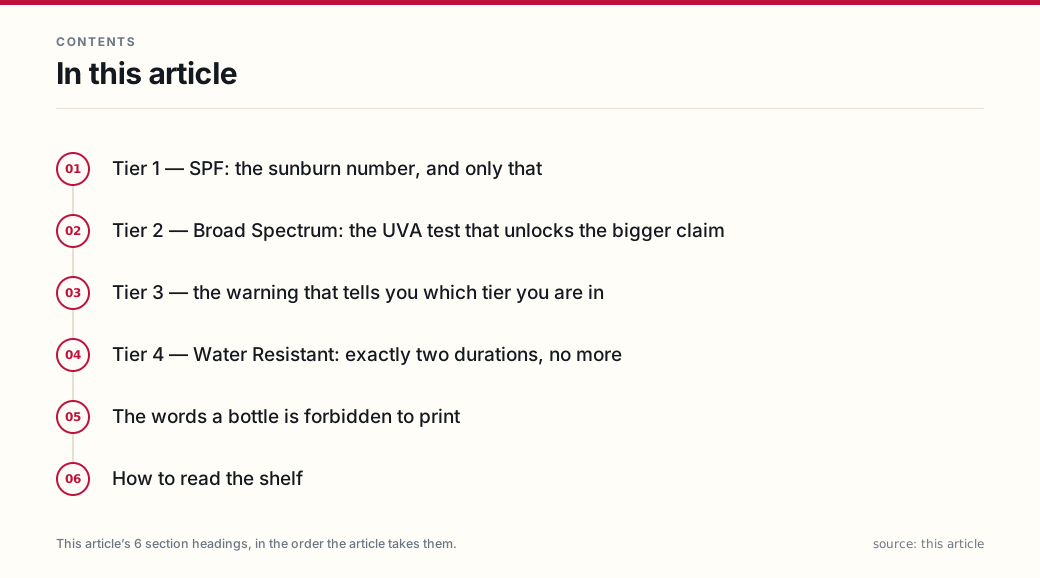
Tier 1 — SPF: the sunburn number, and only that
SPF is a measured result, not a slogan. The monograph requires the number on the front to be “the numerical SPF value resulting from testing under paragraph (i)” — the agency’s standardized test on human subjects. A bottle that says SPF 30 is promising, and is only permitted to promise, that it prevents sunburn at that tested multiple.
Crucially, an SPF-only bottle says nothing about UVA, the band of light tied to skin aging and, separately, to skin-cancer risk. If the bottle does not also say Broad Spectrum, the regulation treats it as a sunburn claim and nothing more — and it forces the bottle to say so itself (see Tier 3).
Tier 2 — Broad Spectrum: the UVA test that unlocks the bigger claim
“Broad Spectrum” is earned by passing the critical-wavelength test in 21 CFR 201.327(j). The critical wavelength is the point at which the integrated absorbance curve reaches 90 percent of the total area from 290 to 400 nm. A product whose mean critical wavelength is 370 nm or greater is classified as broad spectrum. That single number is the government’s UVA yardstick — a measured width of protection, not a phrase a manufacturer can attach on its own.
Why it matters to you: only a Broad Spectrum product with an SPF of 15 or higher may, under 21 CFR 201.327(c)(2), state that — used as directed with other sun protection measures — it decreases the risk of skin cancer and early skin aging caused by the sun. A bottle without Broad Spectrum cannot make that statement at all. And there is a trap at the bottom of this tier: a Broad Spectrum product with an SPF below 15 still lands back in the warning bucket, because the rule keys off both conditions, not just one.
There is also a formatting rule worth knowing. When a bottle says Broad Spectrum SPF, 21 CFR 201.327(a)(1)(i)(B) requires that phrase to appear as continuous text, same font, size, and color, with no graphic or words breaking it up. That is why you see it printed as one unbroken block — the regulation dictated the presentation, not the designer.
Tier 3 — the warning that tells you which tier you are in
The clearest signal of what a bottle is not allowed to claim sits in the Warnings box. Under 21 CFR 201.327(d)(2), any product that is not broad spectrum — and any broad-spectrum product below SPF 15 — must carry the “Skin Cancer/Skin Aging Alert.” In bold, it says the product “has been shown only to help prevent sunburn, not skin cancer or early skin aging.”
So the ladder resolves like this:
| What the bottle says | What it may claim | What it must warn |
|---|---|---|
| SPF only (no Broad Spectrum) | Helps prevent sunburn | Skin Cancer/Skin Aging Alert |
| Broad Spectrum, SPF below 15 | Helps prevent sunburn | Skin Cancer/Skin Aging Alert |
| Broad Spectrum, SPF 15 or higher | May also claim reduced skin-cancer and early-skin-aging risk | No alert required |
And the mirror rule, at 21 CFR 201.327(c)(3): any labeling that suggests sunscreen alone reduces or prevents skin cancer or early skin aging is misbranded. The cancer/aging claim is always chained to the other measures printed under Directions.
Tier 4 — Water Resistant: exactly two durations, no more
Water resistance is the most tightly fenced claim on the bottle. The monograph permits only two water-resistance statements, and each is tied to a specific immersion test in 21 CFR 201.327(i)(7):
- Water Resistant (40 minutes) — the SPF is measured after 40 minutes of water immersion (two 20-minute swims with a 15-minute rest between).
- Water Resistant (80 minutes) — the same idea after 80 minutes.
There is no third option. A bottle cannot say “all-day,” cannot say “waterproof,” and cannot invent a duration. The reapplication language follows the tier: a water-resistant product tells you to reapply after 40 or 80 minutes of swimming or sweating and immediately after towel drying; every sunscreen, resistant or not, tells you to reapply at least every 2 hours and to apply liberally 15 minutes before sun exposure (21 CFR 201.327(e)).
The words a bottle is forbidden to print
21 CFR 201.327(g) lists claims that are false and misleading on sunscreen and therefore make the product misbranded under the Federal Food, Drug, and Cosmetic Act: “Sunblock,” “sweatproof,” and “waterproof” — “these or similar claims.” That is why a modern bottle never calls itself waterproof. The list is “include but are not limited to,” so marketing cousins of those words land in the same prohibited bucket. If you see “waterproof” on a bottle today, it predates the rule or is non-compliant, not a special grade of protection.
How to read the shelf
Start with the front panel. If the phrase is Broad Spectrum SPF 15+, the bottle has cleared the highest rung: tested for UVA width and permitted to claim reduced skin-cancer and aging risk alongside sunburn protection. If it says SPF with no Broad Spectrum, it is a sunburn product and is required to say so. If it says Water Resistant (40/80 minutes), that is the only honest water-resistance promise there is. And if it says waterproof or sunblock, the word itself tells you the label is breaking the rule.
None of this is a judgment about which bottle to buy. It is the ladder the regulation built, and the words are the rungs. The bottle that prints the most words is not automatically the strongest — it is the one that has climbed to the tier whose claim it is allowed to make.
Frequently asked questions
- If a bottle just says 'SPF 50' and nothing else, what does it promise?
- Only that it prevents sunburn at a tested multiple — the SPF number is the result of the test in 21 CFR 201.327(i), not a number the maker picked. Because it does not say Broad Spectrum, the product did not pass the UVA test in paragraph (j), so by 21 CFR 201.327(d)(2) its label must carry the 'Skin Cancer/Skin Aging Alert' stating it has been shown only to help prevent sunburn, not skin cancer or early skin aging. An SPF-only bottle is a sunburn claim, nothing more.
- What does 'Broad Spectrum' actually require a product to do?
- Pass the critical-wavelength test in 21 CFR 201.327(j). The critical wavelength is the point where the integrated absorbance curve reaches 90 percent of the area from 290 to 400 nm, and a mean of 370 nm or greater is classified as broad spectrum. That is the government's UVA yardstick: it is a measured spectrum width, not a marketing phrase a brand can attach on its own.
- Why do I only ever see 'Water Resistant (40 minutes)' or 'Water Resistant (80 minutes)' — never 'all-day'?
- Because those are the only two durations the regulation recognizes. 21 CFR 201.327(a)(2) permits exactly two water-resistance statements, tied to the 40-minute and 80-minute water-immersion tests in paragraph (i)(7); and 21 CFR 201.327(g) makes 'waterproof,' 'sweatproof,' and 'sunblock' — and similar claims — false and misleading, which makes the product misbranded. There is no legal 'all-day' water-resistance claim, so a bottle cannot make one.
- My sunscreen says 'Broad Spectrum SPF 30.' Does that mean it prevents skin cancer?
- It means the product may say so — but only conditionally. 21 CFR 201.327(c)(2) lets a Broad Spectrum SPF 15-or-higher product state that, used as directed with other sun protection measures, it decreases the risk of skin cancer and early skin aging. The companion rule at 21 CFR 201.327(c)(3) makes any message implying sunscreen alone prevents skin cancer or early skin aging misbranded. So the claim is real but is always tied to the other measures printed under 'Directions.'
- How often does the label say to reapply, and where does that come from?
- 21 CFR 201.327(e) sets the reapplication language. Every sunscreen must direct you to apply liberally 15 minutes before sun exposure and to reapply at least every 2 hours. A water-resistant product adds reapplication after 40 or 80 minutes of swimming or sweating and immediately after towel drying; a non-water-resistant product instead tells you to use a water-resistant sunscreen if swimming or sweating. The 'every 2 hours' line is in the monograph for all products.
Sources
Each source is a primary or official reference, checked before publication. Links open the original.
- 21 CFR 201.327 — Over-the-counter sunscreen drug products; required labeling based on effectiveness testing. The claims ladder the article is built on: the principal-display-panel effectiveness statement, split into Broad Spectrum SPF (for products passing the paragraph (j) test) and SPF alone (for those that do not), at (a)(1); the two permitted water-resistance statements, 'Water Resistant (40 minutes)' and 'Water Resistant (80 minutes),' at (a)(2); the statement of identity as 'sunscreen' at (b); the required 'helps prevent sunburn' indication for all products and the conditional skin-cancer/skin-aging-reduction statement for Broad Spectrum SPF 15 or higher at (c)(1) and (c)(2), with the misbranding rule for any implication that sunscreen alone prevents those outcomes at (c)(3); the warning set, including the 'Skin Cancer/Skin Aging Alert' required for non-broad-spectrum products and for broad-spectrum products below SPF 15, at (d)(1) and (d)(2); the Directions, including the 15-minutes-before, every-2-hours, and water-resistance reapplication language at (e)(1) through (e)(4); the prohibited 'Sunblock,' 'sweatproof,' and 'waterproof' claims at (g); the SPF test procedure at (i); the 40- and 80-minute water-immersion tests at (i)(7); and the broad-spectrum critical-wavelength test and its 370 nm threshold at (j). The section's own source note reads '[76 Fed. Reg. 35660, June 17, 2011, as amended at 76 Fed. Reg. 38975, July 5, 2011]', and the paragraph (j) amendment note carries the same cite (ecfr.gov/current/title-21/section-201.327 the same text as the Code of Federal Regulations prints it at govinfo.gov/content/pkg/CFR-2026-title21-vol4/xml/CFR-2026-title21-vol4-sec201-327.xml)
- Labeling and Effectiveness Testing; Sunscreen Drug Products for Over-the-Counter Human Use — final rule, 76 Fed. Reg. 35620 (June 17, 2011), FR Doc. 2011-14766. The rule that established the labeling and effectiveness-testing requirements § 201.327 codifies, including the critical-wavelength broad-spectrum test the section places in paragraph (j); the published rule carries that paragraph at page 35660 of the same document, which is the page the section's source note cites. federalregister.gov/documents/2011/06/17/2011-14766/labeling-and-effectiveness-testing-sunscreen-drug-products-for-over-the-counter-human-use
- Same rule, document of July 5, 2011 — 76 Fed. Reg. 38975, FR Doc. C1-2011-14766. The document the section's source note records as the amendment to paragraph (j). federalregister.gov/documents/2011/07/05/C1-2011-14766/labeling-and-effectiveness-testing-sunscreen-drug-products-for-over-the-counter-human-use