What each sodium claim on a US food label is allowed to mean
Sodium-free, low sodium, reduced sodium, lightly salted: each phrase is defined by federal rule, with a number behind it. The thresholds, and the traps.
The words on the front of a package are not marketing copy. In the United States, a claim about the sodium in a food is a defined term with a number behind it, and a product may only use the term if it meets the definition. That makes the words worth reading — provided you read them as what they are: thresholds, not rankings.
The catch is that two of the most common claims are relative. “Reduced sodium” does not tell you how much sodium is in the package; it tells you the package has a quarter less than some other package. A 600 mg soup made from an 800 mg original is reduced, and it is not low. The table below is the whole ladder, with the rule behind each rung.
This is federal labeling law, so it applies nationwide — the thresholds are set by the Food and Drug Administration in 21 CFR part 101, not by state law, and they are the same on a package sold in any state.
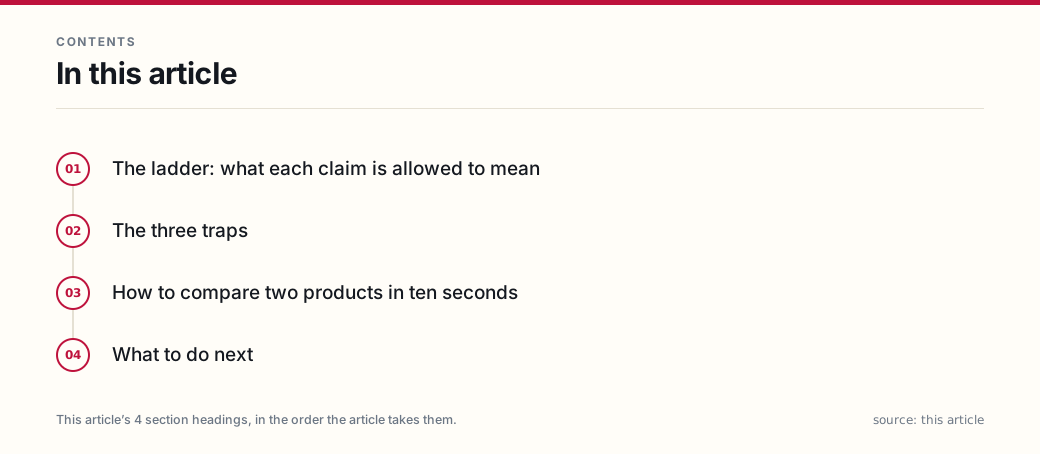
The ladder: what each claim is allowed to mean
| Claim on the label | What the food must contain | Rule |
|---|---|---|
| Salt free, sodium free, no sodium, zero sodium | Less than 5 mg per reference amount and per labeled serving, and no ingredient that is sodium chloride or generally understood to contain sodium unless an asterisk discloses it adds a trivial amount | 21 CFR 101.61(b)(1), (c)(1) |
| Very low sodium | 35 mg or less per serving | FDA claim table; the 35 mg figure appears in the regulation’s own worked example |
| Low sodium | 140 mg or less per reference amount | 21 CFR 101.61(b)(4) |
| Reduced sodium, less sodium, lower sodium | At least 25 percent less sodium per reference amount than the reference food, with the reference food and the percentage stated next to the claim and the comparison quantified | 21 CFR 101.61(b)(6) |
| Light in sodium, lite in sodium | At least 50 percent less sodium than the reference food, for a food whose reference product contains more than 40 calories or more than 3 g of fat per reference amount; for a meal or main dish product the food must instead qualify as low in sodium | 21 CFR 101.56(c)(2), (d)(2) |
| Lightly salted | 50 percent less sodium than is normally added to the reference food; if the product is not low in sodium it must say “not a low sodium food” next to the nutrition label | 21 CFR 101.56(g) |
| Unsalted, without added salt, no salt added | No salt added during processing, and the food it resembles is normally processed with salt; if the food is not sodium free, “not a sodium free food” or “not for control of sodium in the diet” must appear next to the nutrition label | 21 CFR 101.61(c)(2) |
The three traps
1. Relative claims hide the absolute number. “Reduced sodium” and “light in sodium” are measured against the reference food — normally the same manufacturer’s regular version. The rule requires the label to name that reference food and state the percentage, and to give the quantity, e.g. “Sodium content has been lowered from 300 to 150 mg per serving.” When a label does that, use the two numbers rather than the adjective. When a label emphasises the adjective and buries the numbers, that is information too.
2. “No salt added” is about the process. It says salt was not added; it does not say the food is low in sodium, because foods contain sodium that arrives in other ingredients — the FDA names monosodium glutamate, sodium bicarbonate (baking soda), sodium nitrite and sodium benzoate among them. The rule makes the label say so out loud: if the food is not sodium free, the package must carry “not a sodium free food” or “not for control of sodium in the diet” near the nutrition label.
3. The serving is not the package. Every threshold above is per reference amount — a standardized serving defined for the food type — or per labeled serving depending on the claim, and the two can differ. Where the label’s serving differs from the reference amount and the product meets the criterion only on the reference-amount basis, the claim has to state its basis on the label; the regulation’s own example is a beverage marked “Very low sodium, 35 mg or less per 240 mL (8 fl oz)”. Practically: check the serving size, check how many servings the container holds, then multiply by what you will actually eat.
How to compare two products in ten seconds
- Look at the sodium line in milligrams, not the front of the pack. The percentage Daily Value is the fastest screen: the Daily Value for sodium is less than 2,300 mg per day, and the FDA’s guidance is that 5 percent of the Daily Value or less per serving is low while 20 percent or more is high. Getting less than 100 percent of the Daily Value across a day is the agency’s own framing.
- If serving sizes differ, compare per 100 g. The nutrition panel usually offers no per-100 g column, but the arithmetic is easy: divide the sodium by the grams in the serving and multiply by 100. This is the only way to compare a soup with a sauce or a cracker with a chip.
- Rinse, drain, or dilute where you can. The FDA’s own tips include rinsing canned beans, tuna and vegetables, which removes some of the sodium before the food reaches the plate.
- Look at where the sodium actually comes from. The FDA says more than 70 percent of dietary sodium arrives in packaged and prepared food rather than from the salt shaker, and it reports a CDC analysis that about 40 percent of intake comes from a short list: deli meat sandwiches, pizza, burritos and tacos, soups, savory snacks, poultry, pasta mixed dishes, burgers and egg dishes. Those are ordinary meals, not obviously salty ones — which is why taste is not a reliable guide. Cereals and pastries are named on the same page as foods that contain sodium without tasting salty, and bread adds up precisely because a single slice does not look like much.
- Read the ingredient list as well as the panel if you watch anything besides sodium. Ingredient lists are ordered by weight, and a reformulated product’s list is where a substitute shows up — why that matters is here, and why potassium is the one to look for is here.
What to do next
- Set your own number first. If a clinician has given you a daily sodium target, that target governs, and it may be lower than the Daily Value. Nothing on a package overrides it.
- Use the relative claims as a starting point, not an answer. A “reduced sodium” product can be a genuine improvement over the regular version and still be a high-sodium food for you.
- Check the reference product before paying a premium. The percentages and quantities are on the label precisely so that the comparison can be made in the aisle.
- Expect the shelf to shift slowly. The FDA’s 2026 salt-substitute rule lets standardized foods — bread, cheese, canned vegetables and many others — use salt substitutes from December 14, 2026, without requiring anyone to reformulate, so the panel on a product you buy may change without notice.
More primary sources behind this piece, and the rest of the library, are collected in the network’s official government resources directory.
This article is educational content for general information only and is not professional advice. It is not medical advice, and it does not set an individual sodium limit: your own target is a clinical decision, not a label claim.
Frequently asked questions
- Is 'reduced sodium' the same as 'low sodium'?
- No, and the difference is the number behind the claim. 'Reduced sodium' means at least 25 percent less sodium than the reference product under 21 CFR 101.61(b)(6) — a relative test, measured against that company's own regular version. 'Low sodium' is an absolute test: 140 mg or less per reference amount under 101.61(b)(4). A product can be reduced and still be nowhere near low, which is why relative claims have to name the reference food and state the percentage next to the claim.
- Does 'no salt added' mean the food is sodium free?
- No. The rule allows 'unsalted', 'without added salt' and 'no salt added' only where no salt is added during processing and the food it resembles is normally processed with salt — and where the food is not sodium free, the label has to carry the statement 'not a sodium free food' or 'not for control of sodium in the diet' next to the nutrition label. That is the federal acknowledgment, in the regulation itself, that the two claims are different things.
- Is the number on the label for the whole package?
- It is for one serving, and the serving is usually not the whole package. The FDA's own guidance is to check the serving size and the number of servings you actually eat or drink. A can of soup that holds two servings carries double the sodium printed on the panel, and a claim that meets its threshold per reference amount — rather than per the label's own serving — has to state that basis on the label.
Sources
Each source is a primary or official reference, checked before publication. Links open the original.
- 21 CFR 101.61 — nutrient content claims for the sodium content of foods: 'sodium free' and its synonyms require less than 5 mg per reference amount customarily consumed and per labeled serving (§ 101.61(b)(1)); 'low sodium' requires 140 mg or less per reference amount (§ 101.61(b)(4)); 'reduced sodium', 'less sodium' and 'lower sodium' require at least 25 percent less sodium per reference amount than an appropriate reference food, with the reference food and the percentage declared next to the claim and the quantitative comparison shown (§ 101.61(b)(6)); 'salt free' may be used only where the food is 'sodium free' (§ 101.61(c)(1)); 'unsalted', 'without added salt' and 'no salt added' require that no salt be added during processing, that the food it resembles normally be processed with salt, and — if the food is not sodium free — that the statement 'not a sodium free food' or 'not for control of sodium in the diet' appear adjacent to the nutrition label (§ 101.61(c)(2)) (ecfr.gov/current/title-21/section-101.61)
- 21 CFR 101.56 — nutrient content claims for 'light' or 'lite': 'light in sodium' or 'lite in sodium' may be used on a food reduced by 50 percent or more in sodium compared with the reference food, for a product whose reference food contains more than 40 calories or more than 3 g of fat per reference amount, and may not be made where the reference food already meets the definition of low in sodium (§ 101.56(c)(2)); for meal and main-dish products the term requires instead that the food meet the definition of low in sodium (§ 101.56(d)(2)); 'lightly salted' may be used where 50 percent less sodium than is normally added to the reference food has been added, provided that if the product is not 'low in sodium' the statement 'not a low sodium food' appears adjacent to the nutrition label (§ 101.56(g)) (ecfr.gov/current/title-21/section-101.56)
- 21 CFR 101.13 — general nutrient content claim requirements, including the rule that the reference amount customarily consumed in § 101.12 governs whether a product meets a claim and that where the labeled serving differs from the reference amount and the food meets the criterion only on that basis, the claim must be followed by the criteria on which it is made; the regulation's own example is a beverage labeled 'Very low sodium, 35 mg or less per 240 mL (8 fl oz)' (ecfr.gov/current/title-21/section-101.13)
- 21 CFR 101.4 — ingredients must be listed by common or usual name in descending order of predominance by weight, on either the principal display panel or the information panel; ingredients present at 2 percent or less by weight may be listed at the end after a quantifying statement (ecfr.gov/current/title-21/section-101.4)
- US Food and Drug Administration — 'Sodium in Your Diet': the Daily Value for sodium is less than 2,300 milligrams per day, about a teaspoon of table salt; 5 percent of the Daily Value or less per serving is considered low and 20 percent or more is considered high; the page's claim table gives salt/sodium-free as less than 5 mg per serving, very low sodium as 35 mg or less, low sodium as 140 mg or less, reduced sodium as at least 25 percent less than the regular product, light in sodium or lightly salted as at least 50 percent less, and no-salt-added or unsalted as no salt added during processing with no guarantee that the food is sodium free; Americans eat on average about 3,400 mg of sodium per day, and more than 70 percent of dietary sodium comes from packaged and prepared foods rather than the salt shaker; the page names monosodium glutamate, sodium bicarbonate, sodium nitrite and sodium benzoate among additives that contribute sodium (fda.gov/food/nutrition-education-resources-materials/sodium-your-diet)
- US Food and Drug Administration — 'Sodium in Your Diet', food choices section, citing the Centers for Disease Control and Prevention: about 40 percent of the sodium Americans consume comes from deli meat sandwiches, pizza, burritos and tacos, soups, savory snacks, poultry, pasta mixed dishes, burgers, and egg dishes and omelets; the page adds that sodium content varies significantly between similar foods and that some foods not tasting salty, such as cereals and pastries, are still sources of sodium (fda.gov/food/nutrition-education-resources-materials/sodium-your-diet)