How to Read the Nutrition Facts Label Without Memorizing Numbers
Serving size, calories, the nutrients to limit, the ones to get enough of, and % Daily Value — the five parts of the label that decide what you buy.
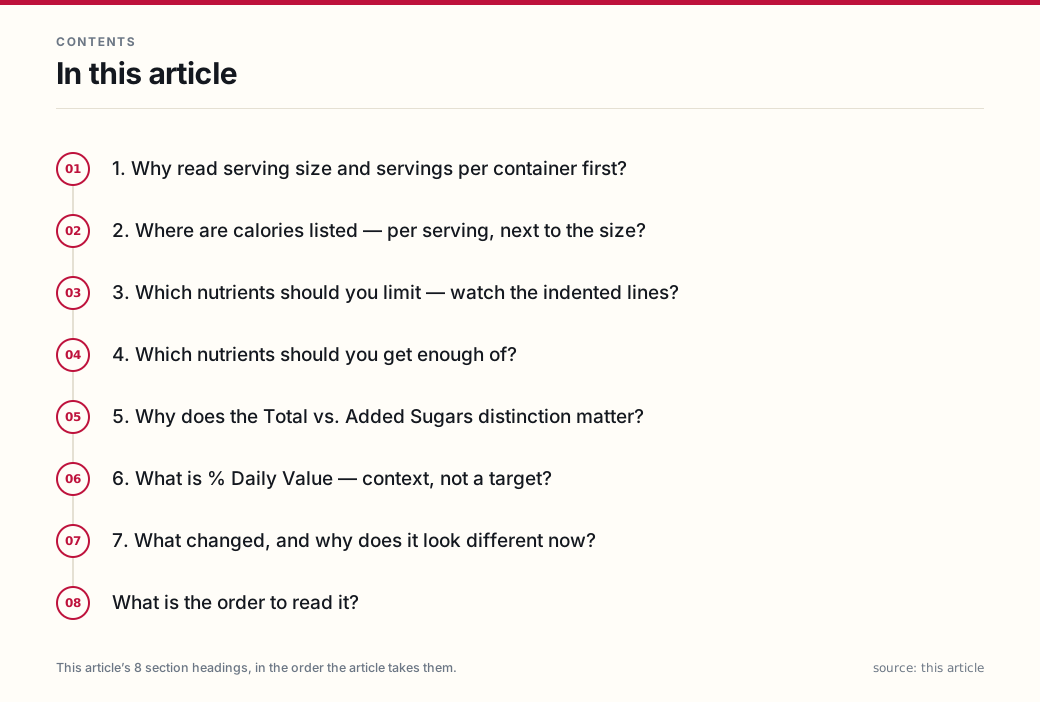
Every packaged food in the United States carries the same box in the same corner: the Nutrition Facts label. You do not need to memorize daily targets to use it. You need to know which five parts move your decision, and in what order to read them. Everything else on the label is context.
This is about reading the label, not about what any one person should eat. If you have a condition or a clinician’s advice, that overrides the general guidance below.
1. Why read serving size and servings per container first?
Almost everything else on the label is “per serving,” so the serving size sets the scale. Two numbers matter: serving size (the reference amount) and servings per container (how many of those are in the package).
Serving sizes are set by law from what people actually eat, not what they should eat — the reference amount customarily consumed. Two consequences are worth knowing:
- A package that holds between one and two servings (a 20-ounce soda, a 15-ounce can of soup) is labeled as a single serving, because people usually finish it in one sitting.
- A larger package that could be eaten in one sitting or across several (a 24-ounce soda, a pint of ice cream) carries a dual-column label: nutrients shown both “per serving” and “per package.” If you eat the whole thing, the per-package column is the one you actually ate.
If you only compare the calorie or sodium number without checking the serving size, you are comparing different amounts of food.
2. Where are calories listed — per serving, next to the size?
Calories sit next to serving size for a reason: a 250-calorie serving means little until you know whether the package is one serving or four. Use calories together with the serving-size pair, not on their own.
3. Which nutrients should you limit — watch the indented lines?
Under Total Fat, three lines are indented and worth your attention: Saturated Fat, Trans Fat, and (above them) the sodium and added-sugars lines. These are the nutrients most Americans are advised to keep from going over. Each carries a % Daily Value, and the label’s own rule of thumb is simple: 5% DV or less is low, 20% DV or more is high.
Trans Fat is the strictest: the label can read “0 g” if a serving has less than 0.5 g, so a product claiming “0 g trans fat” can still contain a little — check the ingredient list for “partially hydrogenated” oils if that matters to you.
4. Which nutrients should you get enough of?
The label requires a core set of nutrients to be declared: dietary fiber, vitamin D, calcium, iron, and potassium, alongside the fats, sodium, total carbohydrate, added sugars, and protein. Vitamin D, calcium, iron, and potassium are required because they are nutrients of public-health significance. Vitamins A and C used to be required and are now voluntary — a product may list them, but it does not have to.
“Enough of” here just means these are the lines where a higher % DV is generally the direction you want, as part of an overall diet. None of it is a personal prescription.
5. Why does the Total vs. Added Sugars distinction matter?
Total Sugars is the whole amount: sugars naturally present in fruit and dairy plus any added during processing. Directly beneath it, indented, is Includes X g Added Sugars — the portion that was added during processing or packaged as such (table sugar, syrups, honey, fruit-juice concentrates).
That split is the most useful new line on the label. A plain yogurt can have high Total Sugars from lactose and zero Added Sugars; a soda can have the same Total Sugars almost entirely from added sources. The indented line tells you which one you are looking at.
6. What is % Daily Value — context, not a target?
The right-hand % Daily Value column shows how much of a day’s reference amount one serving provides, using a 2,000-calorie diet as the general reference. It is a quick comparison tool, not your personal number. Five percent or less is low; twenty percent or more is high. That is all you need to rank two cereals or two sauces against each other without knowing the gram amounts underneath.
7. What changed, and why does it look different now?
The current label was finalized in 2016 and fully phased in by 2021. The changes that explain what you see today:
- Added Sugars became a required line (grams and % DV), indented under Total Sugars.
- Vitamin D and potassium became required; vitamins A and C became voluntary.
- “Calories from Fat” was removed — the type of fat matters more than the fat calories.
- Daily Values were updated for nutrients like sodium, dietary fiber, and vitamin D based on newer evidence.
- Serving sizes were updated to reflect what people actually eat.
None of that changes how you read it; it just explains why an older label next to a newer one looks different.
What is the order to read it?
- Serving size + servings per container — is this one serving or the whole box?
- Calories — against that serving size.
- Saturated fat, trans fat, sodium, added sugars — keep these toward the low end.
- Fiber, vitamin D, calcium, iron, potassium — higher % DV is generally the direction you want.
- % Daily Value — your quick compare-this-to-that number.
Read those five, in that order, and the label does its job: it tells you what is actually in the package you are holding, in terms you can act on at the shelf.
Frequently asked questions
- What is the difference between Total Sugars and Added Sugars?
- Total Sugars is everything in the product — both sugars that occur naturally (in fruit, milk, plain yogurt) and sugars added during processing. Added Sugars is only the second part: sugars added during processing or packaged as such (table sugar, honey, syrups, concentrates). On the label, 'Includes X g Added Sugars' is printed indented directly under Total Sugars so you can see how much of the total came from added sources.
- Why did the label drop 'Calories from Fat'?
- The 2016 update removed 'Calories from Fat' because nutrition science moved on: the type of fat matters more than the total fat calories. Total Fat, Saturated Fat, and Trans Fat are still required, and the saturated and trans lines are the ones to watch.
- What does % Daily Value actually mean?
- It is the share of a day's reference amount in one serving, based on a 2,000-calorie diet used for general nutrition advice — not a personal target. The label's own guide is that 5% DV or less of a nutrient is 'low' and 20% DV or more is 'high,' which lets you compare foods without knowing the underlying gram amounts.
- Are serving sizes a recommendation of how much to eat?
- No. By law, serving sizes are based on what people actually eat, not what they should eat (the reference amount customarily consumed). That is why a 20-ounce soda is labeled as one serving and why some larger packages carry a dual-column label showing both 'per serving' and 'per package.'
Sources
Each source is a primary or official reference, checked before publication. Links open the original.
- 21 CFR 101.9 — Nutrition labeling of food (mandatory nutrients, format, added sugars, serving size basis) — govinfo.gov/content/pkg/CFR-2025-title21-vol2/xml/CFR-2025-title21-vol2-sec101-9.xml
- FDA, Food Labeling: Revision of the Nutrition and Supplement Facts Labels, 81 Fed. Reg. 33742 (May 27, 2016) — federalregister.gov/documents/2016/05/27/2016-11867/food-labeling-revision-of-the-nutrition-and-supplement-facts-labels
- FDA, Serving Sizes of Foods That Can Reasonably Be Consumed At One Eating Occasion; Dual-Column Labeling; Updating, Modifying, and Establishing Certain Reference Amounts Customarily Consumed; Serving Size for Breath Mints; and Technical Amendments, 81 Fed. Reg. 34000 (May 27, 2016) — federalregister.gov/documents/2016/05/27/2016-11869/food-labeling-serving-sizes-of-foods-that-can-reasonably-be-consumed-at-one-eating-occasion-dual-column-labeling