Duplicate ingredients in OTC drugs: the acetaminophen box warning
Duplicate acetaminophen is the one OTC risk the rule manages with a prohibition rather than a number — and that prohibition reaches prescription drugs too.
There is one risk in over-the-counter medicine that the federal rule does not try to manage with a number. It manages it with a prohibition, printed on the box, in words that most people read past: “Do not use with any other drug containing acetaminophen (prescription or nonprescription).”
That sentence is not advice. It is required text. 21 CFR 201.326 sets the warnings for every OTC drug product containing an internal analgesic or antipyretic ingredient, “alone or in combination,” and the prohibition is one of them. The rest of this page is about what that structure means in practice — because the choice to prohibit rather than to quantify is the whole reason the duplicate-ingredient problem survives on shelves full of correctly labeled products.
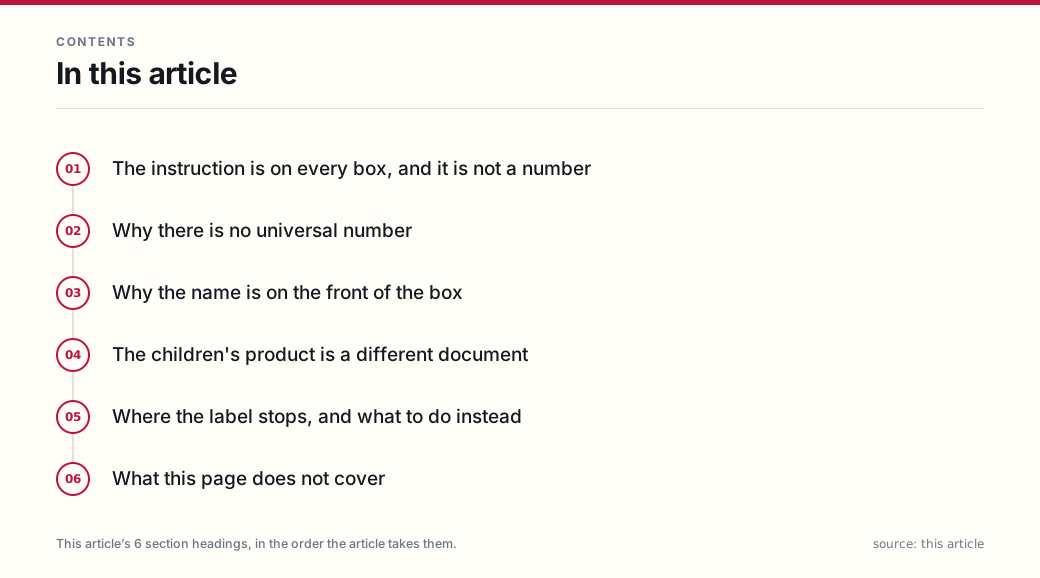
The instruction is on every box, and it is not a number
The required warning, at § 201.326(a)(1)(iii)(B), is short and worth reading slowly:
“Do not use with any other drug containing acetaminophen (prescription or nonprescription). If you are not sure whether a drug contains acetaminophen, ask a doctor or pharmacist.”
Three things are doing work in that sentence.
“Any other drug” — not “any other OTC drug.” The parenthetical makes the reach explicit: prescription products are inside the prohibition. This is the part people miss, and the reason the parenthetical exists is that the most common source of a duplicate is not two boxes on the same shelf. It is an OTC cold product taken alongside a prescription painkiller that already contains the same ingredient, where neither box says anything about the other.
“Containing acetaminophen” — the test is the ingredient, not the product’s stated purpose. A box marketed for cough and congestion is not marketing itself as a pain reliever, and it can still contain the ingredient. The purpose line on the panel describes the product; it does not describe the whole contents.
“If you are not sure … ask a doctor or pharmacist” — the regulation anticipates that the label cannot answer this question and names the two people who can. That is an unusual thing for a labeling rule to concede, and it is there because the alternative would be a claim the label cannot support.
Why there is no universal number
The liver warning is the other required text, and its construction is the most instructive thing in the section. The regulation writes it as:
“Liver warning: This product contains acetaminophen. Severe liver damage may occur if you take [bullet] more than [insert maximum number of daily dosage units] in 24 hours, which is the maximum daily amount [optional: ‘for this product’] [bullet] with other drugs containing acetaminophen [bullet] 3 or more alcoholic drinks every day while using this product”
The brackets are the rule’s own. The number of daily dosage units is not supplied by the regulation — it is inserted from the product’s own directions, and the optional qualifier “for this product” exists precisely because the figure is product-specific. Two boxes with the same active ingredient can carry different amounts per unit, and therefore different maximum daily unit counts.
There is a reason the rule is built this way rather than printing a milligram figure. A universal number would be wrong for at least one of those two boxes. And a separate provision caps the combination case directly: for OTC cough-cold combination products, 21 CFR 341.85(d) provides that where the time intervals or age limitations for the individual ingredients differ, “the directions for the combination product may not exceed any maximum dosage limits established for the individual ingredients in the applicable OTC drug monograph.” A combination cannot prescribe more of an ingredient than that ingredient allows on its own.
So the authority for the maximum is the box in your hand — which is exactly why reading two boxes is the only way to catch a duplicate. The regulation has no number to give you; it has a prohibition instead.
Why the name is on the front of the box
This is the part almost nobody knows, and it is the strongest structural protection in the section. At § 201.326(a)(1)(i)(A), for combination products containing acetaminophen and a nonanalgesic ingredient — a cough-cold product is the example the rule gives — the name “acetaminophen” must appear on the principal display panel, the front of the box, together with the names of the other active ingredients. Only “acetaminophen” has to be highlighted or in bold type, and it has to be in a size that is at least one-quarter as large as the most prominent printed matter on that panel, or at least as large as the “Drug Facts” title — whichever is greater. The rule states the two options as a floor, not a menu; the manufacturer does not get to pick the smaller one.
Read that as what it is: an admission. The Drug Facts panel was not enough to tell a buyer what the box contained, so the rule moved the ingredient name to the front. A product sold for congestion, sold for a cough, sold for a “multi-symptom” formula, is required to name the analgesic on its face.
The parallel provision for the other family of analgesics does the same thing. For nonsteroidal anti-inflammatory ingredients, the word “(NSAID)” must appear highlighted or in bold on the principal display panel, and the stomach-bleeding warning lists among its risk factors “take other drugs containing prescription or nonprescription NSAIDs (aspirin, ibuprofen, naproxen, or others).” Same structure: a name on the front, a prohibition that reaches both prescription and OTC products.
The children’s product is a different document
For products labeled only for children under 12, the regulation changes the warning rather than scaling it. The children’s liver warning states the maximum as “more than 5 doses in 24 hours” — a number, where the adult version has a product-inserted one. And the Directions section must carry, in bold type:
“this product does not contain directions or complete warnings for adult use”
That sentence is required, and it is the regulation acknowledging something real: a children’s product is not a smaller adult product. Its dosing, its warnings and its limits were set for a different population, and the label is required to say so rather than leave a caregiver to assume otherwise.
Where the label stops, and what to do instead
The label can tell you what is in the box. It cannot tell you what is in your other box, and it cannot tell you what is in your prescription. That is the gap the prohibition is standing in for, and it is why the required sentence ends by naming a pharmacist.
Two escalations are worth knowing because they are the cases where the duplicate stops being a numbers question:
- “Ask a doctor before use if you have liver disease.” Required at § 201.326(a)(1)(iii)(C). Liver disease is the condition the liver warning is built around, and it is the one the rule escalates from the warning to a consultation.
- “Ask a doctor or pharmacist before use if you are taking the blood thinning drug warfarin.” Required at (a)(1)(iii)(D), and the only one of the four acetaminophen warnings that names a specific other drug — the section’s other cross-drug warnings name a class, with examples in parentheses. The same sentence carries a limitation that is easy to miss: the warning is excepted on the labeling of combination products that contain both acetaminophen and an NSAID. Those products are not left without an anticoagulant mention, because the NSAID stomach-bleeding warning applies to them too, and its risk factors include “take a blood thinning (anticoagulant) or steroid drug”.
The practical check takes about ten seconds and uses nothing but the panel: read the Active ingredient(s) line on each box you are about to take, and look for the same name appearing twice. The line gives the established name and the amount per dosage unit, which is enough to spot the duplicate — and for a combination product, the front-of-box name requirement means you can often catch it without turning the box around at all.
What this page does not cover
The federal labeling requirements for OTC internal analgesic and antipyretic products under 21 CFR 201.326, the directions rule for OTC cough-cold combinations at 21 CFR 341.85(d), and the current structure of 21 CFR part 343. It does not state a maximum daily dose for acetaminophen, because the regulation does not state one — the figure is product-specific and comes from the directions on the box, which is the point this page is making. It does not cover prescription-drug labeling, which is governed by a different part of the same title; and it does not address what to do after a suspected overdose, which is a medical question rather than a labeling one.
Frequently asked questions
- I take a prescription painkiller. Does the warning really apply to that?
- The regulation's own words are "Do not use with any other drug containing acetaminophen (prescription or nonprescription)." The parenthetical is in the required text, so the warning reaches prescription products by its terms — hydrocodone-acetaminophen and similar combinations are the reason the word is there. What the label cannot do is tell you whether your prescription is one of them; the active-ingredient line on the prescription's own label, or a pharmacist, is the only way to know. The same sentence continues: "If you are not sure whether a drug contains acetaminophen, ask a doctor or pharmacist."
- Why doesn't the label just print the maximum in milligrams?
- Because the regulation deliberately does not. The required liver warning reads "more than [insert maximum number of daily dosage units] in 24 hours, which is the maximum daily amount", with the number left for the product's own directions to supply, and an optional qualifier "for this product" that exists precisely because the number is product-specific. Two boxes containing the same ingredient can carry different per-unit amounts and therefore different maximum daily unit counts. Printing one universal figure would be wrong for at least one of them, so the rule makes the box you are holding the authority.
- A cold and flu product treats fever too. Is that a duplicate risk?
- It can be, and the regulation treats that case as special. Where a combination product contains acetaminophen together with a nonanalgesic ingredient — a cough-cold combination is the example the rule gives — the name "acetaminophen" is required to appear on the principal display panel, the front of the box, along with the names of the other active ingredients. Only "acetaminophen" has to be highlighted or in bold. The requirement exists because the Drug Facts panel alone was not enough to tell a buyer what the box contained.
- My child's medicine says it has no directions for adults. Why?
- Because the regulation requires it to say so. For products labeled only for children under 12, the Directions section must carry, in bold type, "this product does not contain directions or complete warnings for adult use". The children's liver warning also differs: "more than 5 doses in 24 hours" is the stated maximum rather than a product-inserted number. A children's product is not a smaller adult product; it is a differently labeled document.
- Does the same problem exist with ibuprofen or aspirin?
- Yes, and the rule handles it in parallel. For nonsteroidal anti-inflammatory ingredients the word "(NSAID)" must appear highlighted or in bold on the principal display panel, and the required stomach-bleeding warning lists as a risk factor "take other drugs containing prescription or nonprescription NSAIDs (aspirin, ibuprofen, naproxen, or others)". The structure is the same as the acetaminophen rule: a name on the front, and a prohibition that reaches across both prescription and OTC products.
Sources
Each source is a primary or official reference, checked before publication. Links open the original.
- 21 CFR 201.326 — over-the-counter drug products containing internal analgesic/antipyretic active ingredients; required warnings and other labeling. The provision applies to all OTC drug products containing any such ingredient, 'alone or in combination', at (a). For acetaminophen, the statement-of-identity rule at (a)(1)(i)(A) requires that combination products containing acetaminophen and a nonanalgesic ingredient (a cough-cold product is the example given) include the name 'acetaminophen' and the names of the other active ingredients on the principal display panel, with only 'acetaminophen' highlighted or in bold. The liver warning at (a)(1)(iii)(A) reads, in the regulation's own words, 'This product contains acetaminophen. Severe liver damage may occur if you take [bullet] more than [insert maximum number of daily dosage units] in 24 hours, which is the maximum daily amount [optional: for this product] [bullet] with other drugs containing acetaminophen [bullet] 3 or more alcoholic drinks every day while using this product' — note that the rule inserts no number of its own, and that it must be the first warning under the Warnings heading. The duplicate-use prohibition at (a)(1)(iii)(B) is required verbatim: 'Do not use with any other drug containing acetaminophen (prescription or nonprescription). If you are not sure whether a drug contains acetaminophen, ask a doctor or pharmacist.' Also (a)(1)(iii)(C) 'Ask a doctor before use if you have liver disease' and (a)(1)(iii)(D) the warfarin warning 'Ask a doctor or pharmacist before use if you are taking the blood thinning drug warfarin', which the same sentence excepts on the labeling of combination products that contain acetaminophen and NSAID(s); (a)(1)(iv)(A)(1) the children's liver warning with 'more than 5 doses in 24 hours'; (a)(1)(iv)(B) the bold statement 'this product does not contain directions or complete warnings for adult use'; (a)(1)(iii)(A) the placement rule putting the Liver warning after the Reye's syndrome and Allergy alert warnings and before the Stomach bleeding warning for products containing both acetaminophen and aspirin, and the requirement that the warning appear on both the outer and the immediate container and remain intact and readable on a blister card once the product is removed; and (a)(2) the parallel NSAID provisions, including the required '(NSAID)' on the principal display panel and the stomach-bleeding warning listing 'take other drugs containing prescription or nonprescription NSAIDs (aspirin, ibuprofen, naproxen, or others)' among its risk factors (ecfr.gov/current/title-21/section-201.326)
- 21 CFR 341.85(d) — directions for OTC cough-cold combination products: the labeling states directions that conform to those established for each ingredient, and 'when the time intervals or age limitations for administration of the individual ingredients differ, the directions for the combination product may not exceed any maximum dosage limits established for the individual ingredients in the applicable OTC drug monograph.' This is the rule that stops a combination product from prescribing a higher total dose than any single ingredient would allow (ecfr.gov/current/title-21/section-341.85)
- 21 CFR part 343, structure as currently codified: the part covers internal analgesic, antipyretic and antirheumatic drug products, its labeling subpart at 343.50 through 343.60 is marked Reserved, and the active-ingredient sections that remain list cardiovascular ingredients at 343.12 and rheumatologic ingredients at 343.13 (aspirin and buffered aspirin). Cited for the structural point that the labeling requirements for internal analgesics now live in 21 CFR 201.326 rather than in the part 343 labeling subpart (ecfr.gov/current/title-21/part-343)